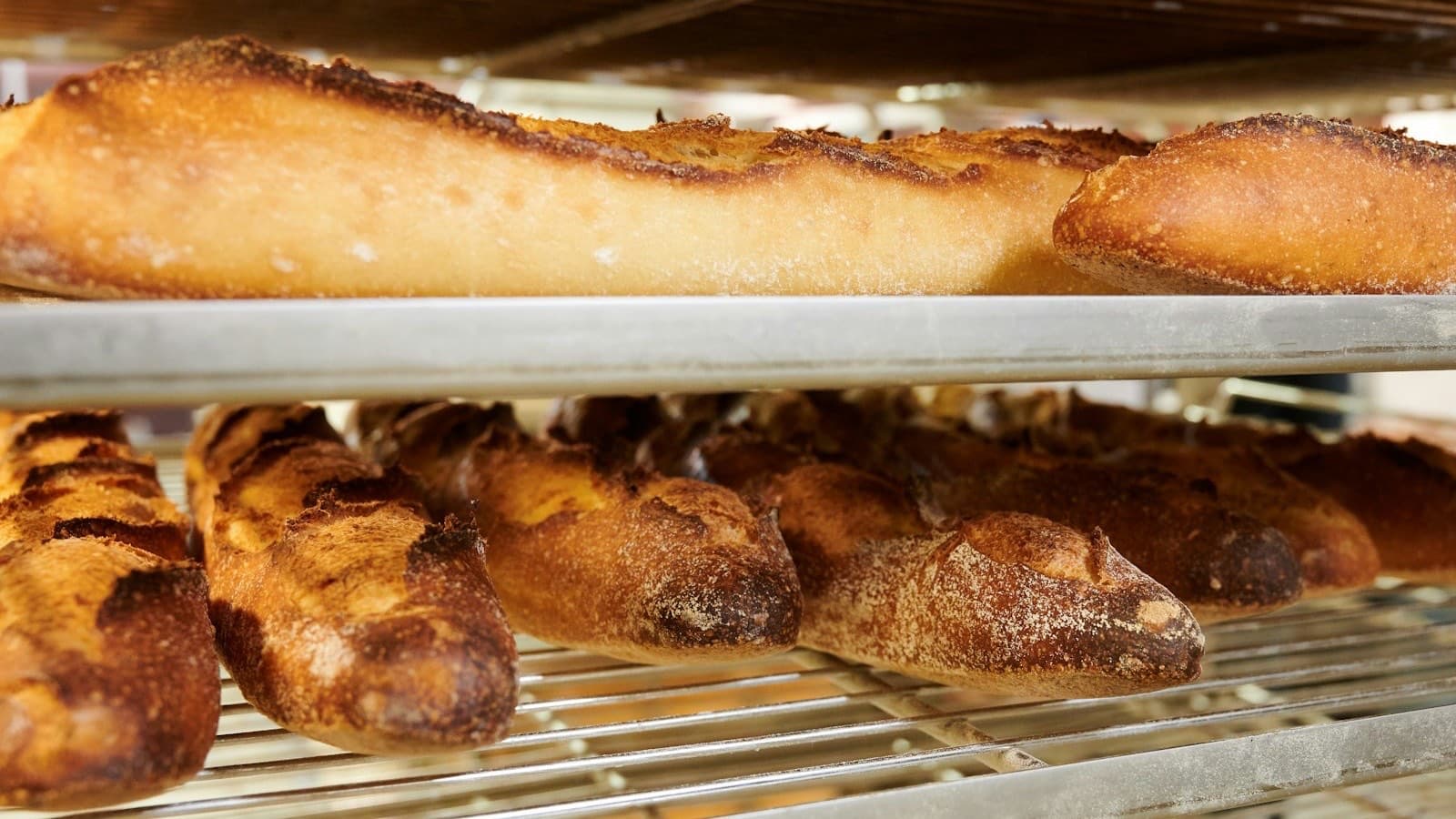
How to run a bakery: night shifts, wholesale, deliveries and the numbers to watch
A bakery runs to a different rhythm than a pastry shop: the night shift, regular customers, the morning route and crates that come back or do not. Eight areas you need to keep under control, and a routine for the day, week and month, from a Polish perspective.
Running a bakery starts with the customer calendar
In a pastry shop most work comes from individual orders: a cake for Saturday, a cake for a First Communion. In a bakery it is the other way round. Most bread and rolls go out in the morning to the same shops, schools and cafes, in almost the same quantities, and the walk-in customer at the counter is only the second layer. That is why running a bakery is mainly about watching three things: who collects how much tomorrow morning and at what price, what the night shift has to bake for that to add up, and whether the van leaves on time. If those three things work without the owner on the phone at 10 p.m., the rest is manageable. A similar article for pastry shops, with different areas, is How to run a pastry shop.
- a list of customers for every day of the week, written once, not reconstructed from memory every evening
- a night shift plan that follows from that list, not from a hunch
- a delivery route and delivery times agreed with customers
- one person who closes the day: tomorrow's orders, corrections, missing ingredients
1. Regular customers and standing orders
A shop takes 40 rolls and 12 loaves from Monday to Saturday, plus sweet buns on Wednesdays. Copying this every evening from a notebook or from messages is a daily risk of mistakes and an hour of work for someone who should already be asleep. A better setup: every customer has a template for every day of the week, and you make corrections (“10 fewer rolls tomorrow”) only on that one day. In BakePilot you enter standing orders once, and every night the system creates orders from them two days ahead; when a customer is on holiday you switch the template off with one field (Mistrzowski (Master) plan). When deliveries vary from week to week, “Copy day” moves all orders from a chosen day to another (from the Profesjonalny (Professional) plan).
- one template per customer and day of the week
- correcting a single day does not change the template
- holidays and customers' vacations planned in advance, not noticed in the morning
2. Prices for wholesale customers
A shop pays differently from a school, and a customer taking 300 rolls a day gets a discount. The trouble starts when these arrangements live in the owner's head or in three versions of a spreadsheet, and after a flour price rise nobody remembers whose price has already been raised. Good practice is a separate price list for each group of customers, with the date it applies from, and assigning the price list to the customer instead of entering a discount by hand on every invoice. In BakePilot price lists have prices with an effective date, and orders and standing orders take the price from the customer's price list automatically (from the Profesjonalny plan). In the Mistrzowski plan you can change a whole price list by a percentage from a given date and set up promotions from - to.
- a price list per customer group, not a discount “from your head”
- a price rise with a date, announced to customers in advance
- once a quarter: compare wholesale prices with the cost of products
3. The overnight production plan
The night shift cannot start by asking what we are baking today. Ideally, before the day shift leaves, a list is ready: how many pieces of each product, from which recipe, how much dough to mix and for how many trays. A recipe written in grams per batch and scaled to the required amount eliminates the night shift's most common mistake: calculating “by eye” when tired. In BakePilot the orders for a given day are visible on the production board, the purchase planner calculates the ingredient requirements from them (from the Profesjonalny plan), and the Production list is a weekly table where the night shift records how much of each product it made, how much was left and how much was rejected (Mistrzowski plan). Production from a recipe scales the ingredients to any number of pieces, kilograms or trays and guides you through weighing stage by stage (Mistrzowski plan). Printing a scaled recipe is described in Printing recipes.
- the night list ready before the end of the day shift
- recipes with amounts per batch, scaled, not calculated in your head
- baking parameters (time, temperature, color) written in the recipe, so every shift bakes the same way
4. Night work, scheduling and working time
A bakery is one of the few trades where night work is the norm, not the exception, so labor law matters more to the owner here than in a pastry shop. Under the Polish Labor Code, night time covers 8 hours between 21:00 and 7:00, and the exact hours are set by the employer (Article 151⁷ § 1).[1] A night worker is someone who works at least 3 hours of night time in each 24-hour period, or for whom at least a quarter of working time in the settlement period falls at night (§ 2).[1] Every hour of work at night earns an allowance of 20% of the hourly rate derived from the minimum wage (Article 151⁸ § 1).[1] On top of that comes the obligation to keep working time records in order to calculate pay correctly (Article 149 § 1).[1] In BakePilot the Time tracking module (Mistrzowski plan) has PIN clock-in on a shared tablet, a shift schedule with shifts across midnight, your own setting for night time and the night allowance, and an hours settlement with a column for night hours and overtime, to export for your accountant.
This is not HR advice
We quote the rules from the consolidated text of the Polish Labor Code. Agree the details of settlements (settlement period, flat rates, particularly arduous work) with your accountant or HR.
5. Deliveries, the route and crates
In the morning the order matters. A driver who goes “in list order” rather than by route loses a quarter of an hour on every round, and the shop at the end gets its bread after opening. The second issue is crates: you hand them out every day, they come back irregularly, and after a month nobody knows how many are at which customer. In BakePilot the deliveries tab for a given day plans the route and opens it in Google Maps, and the printed “Delivery sheet” has addresses, times, items and amounts to collect (route planning, from the Profesjonalny plan). The customer card keeps the crate balance: crates handed out are added when the order is handed over, and you record returns with a button (customer database, crates and deposits in the Mistrzowski plan). You can issue a delivery note (WZ) for every delivery from the Profesjonalny plan (delivery notes).
- a route planned by addresses and delivery times, not by the order of the list
- the delivery sheet printed for the driver before departure
- the crate balance at each customer checked once a week
- a delivery note (WZ) or an invoice with every wholesale delivery
6. The cost of a loaf and ingredients
The margin on bread is low, so profit is decided by pennies. Flour, yeast, oven energy and the night shift's labor add up to a cost that rises quietly: a sack of flour a few zloty more expensive is a real amount when you bake hundreds of loaves a week. It is worth calculating the cost from the recipe per batch, with the flour price from the latest invoice, not from memory. In BakePilot a recipe calculates its cost from the ingredient database, including the energy of the oven and mixer, and after prices change “Recalculate all” updates recipes and products at once (cost calculator, Profesjonalny plan). Invoices from wholesalers downloaded from KSeF (Poland's National e-Invoicing System) update ingredient prices in the Mistrzowski plan (KSeF cost invoices). Stock levels show flour and other ingredients with a minimum threshold (Profesjonalny plan).
- cost per piece and per batch, including oven energy
- the flour price updated after every delivery that brings a change
- a minimum for flour, yeast and other ingredients the night shift cannot work without
7. Shop takings and wholesale numbers
A bakery with its own shop has two money streams: the till takings and what wholesale customers owe. The first is worth knowing every evening, the second once a week, together with the list of customers who are behind on payments. After a month of such records you can see which days of the week and which products really make money, and which shops take a lot but with a discount that eats the margin. In BakePilot the daily report is filled in by the employee closing the shop, also for several points of sale, and analytics show revenue, products, customers and days of the week (Profesjonalny plan). The daily break-even point is calculated by the Finance module in the Mistrzowski plan (break-even point).
- every day: the till report of your own shop
- every week: wholesale sales per customer and overdue payments
- every month: the products and customers with the lowest margin
8. Sanepid, HACCP and KSeF
We describe the sanitary requirements for bakeries (registration, premises, medical certificates, acrylamide, transporting bread) separately in HACCP in a bakery in Poland: Sanepid requirements step by step, Sanepid being the Polish sanitary inspection. In day-to-day management what matters is that temperature records for fridges with fillings and the vehicle cleaning log are kept up to date, not filled in before an inspection. In BakePilot this is done with the HACCP module (Mistrzowski plan), and you can download a paper temperature log as a PDF. Wholesale customers are businesses, so the bakery issues them invoices which since 2026 go through KSeF; what this means in practice is described in KSeF for Polish pastry shops and bakeries.
- temperatures and cleaning recorded on the day they happened
- medical certificates of the night shift and stand-ins up to date
- invoices for wholesale customers issued from one place, with customer details entered once
The bakery routine: day, week, month
In a bakery the day starts in the evening, so it is worth building the owner's routine from the evening too. Below is the setup that works with wholesale and a bakery shop. Start with closing tomorrow's orders in the evening, because a mistake at this point costs the most: either bread is left over or a shop calls in the morning to say something is missing.
| When | What to check | Why |
|---|---|---|
| In the evening, before the night shift | tomorrow's orders with corrections, the production list, flour and other ingredient stock | the night shift bakes exactly what goes out in the morning |
| In the morning, before departure | the route and delivery sheet, crates to hand out, delivery notes (WZ) | the van leaves on time, nothing is left on the loading dock |
| After the shop closes | the till report, equipment temperatures | you know the day's takings, the HACCP record is up to date |
| Once a week | crate balances, customers' overdue payments, the night shift schedule | crates come back, so does the money, and the shift is staffed |
| Once a month | product costs at invoice prices, night hours settlement, sales per customer | wholesale prices keep up with costs, pay is calculated from the records |
Notebook, spreadsheet or bakery software?
An order notebook works in a bakery with a few customers, as long as it is kept by one person who never gets sick. A spreadsheet with a tab for every day of the week is a step further, but it will not scale production, plan a route or tell you how many crates are at which shop. Software makes sense when it connects the areas: a standing order creates tomorrow's order, which goes onto the production list and the delivery sheet, and takes its prices from the customer's price list. That is how our bakery software works. Standing order templates are created from existing orders, and you can import customers, products and ingredients from Excel, so you do not start from scratch.
In a bakery the winner is not the one who bakes the most, but the one who has nothing left over and nothing missing in the morning. That is a matter of an order list closed in the evening, not of talent.
Sources and footnotes
- [1]Act of 26 June 1974, the Labor Code, consolidated text Journal of Laws 2026 item 1245 (Article 149: working time records, Articles 151⁷ and 151⁸: night work) (in Polish), Sejm of the Republic of Poland - Internet System of Legal Acts (ELI), 2026link (opens in a new tab)
Author: Patryk Kowalski. Last updated: . Spotted a mistake? Write to kontakt@bakepilot.pl and we will correct it and update the date. Editorial policy
How would you rate this article?
Your rating helps us write better content for bakers and pastry chefs.
Loading…