
Doughnut, eclair, individual dessert - a product sold by the piece
A full example with 40 doughnuts: a recipe in “Pieces” mode, a product not sold by weight, a “1 pc” variant and a “box of 6” variant. With numbers.
Last updated:
When this scenario applies
You sell pieces, not kilograms or slices from a tray: doughnuts, eclairs, croissants, sweet buns, cupcakes, individual desserts, macarons. One batch yields a set number of pieces and you want to know the cost and profit per piece. In the example we make 40 rose doughnuts.
A recipe in “Pieces” mode
The key to this scenario is the “Pieces” tile in the “The batch yields” section and the two fields under it: “Batch weight (kg)” and “Pieces per batch”. The weight is the whole batch - all 40 doughnuts together, not one. You also enter the ingredients for the whole batch.
- Recipes, New. Name “Rose doughnuts”, category Small bakes, pricing method “Margin %”, margin 45.
- Select the “Pieces” tile. The hint under the weight field changes to “How much the whole batch from one recipe portion weighs - all pieces together, not one”.
- Batch weight: 3.2 (kg). Pieces per batch: 40.
- Ingredients for 40 pieces: flour 1000 g, sugar 120 g, butter 100 g, eggs 4 pcs, yeast 60 g, milk 450 g, rose jam 600 g, frying oil 500 g, powdered sugar 150 g.
- Equipment: a 1.2 kW mixer for 0.3 h. Additional costs: packaging 4 PLN, cleaning 2 PLN, water 1 PLN.
- Create the recipe.
Tip: In Pieces mode you can only choose “Margin %” and “Price per piece”. If you want to set the doughnut price up front (for example 5.50 PLN), choose “Price per piece” - the system will calculate the margin from it instead of the other way round.
What the recipe card shows
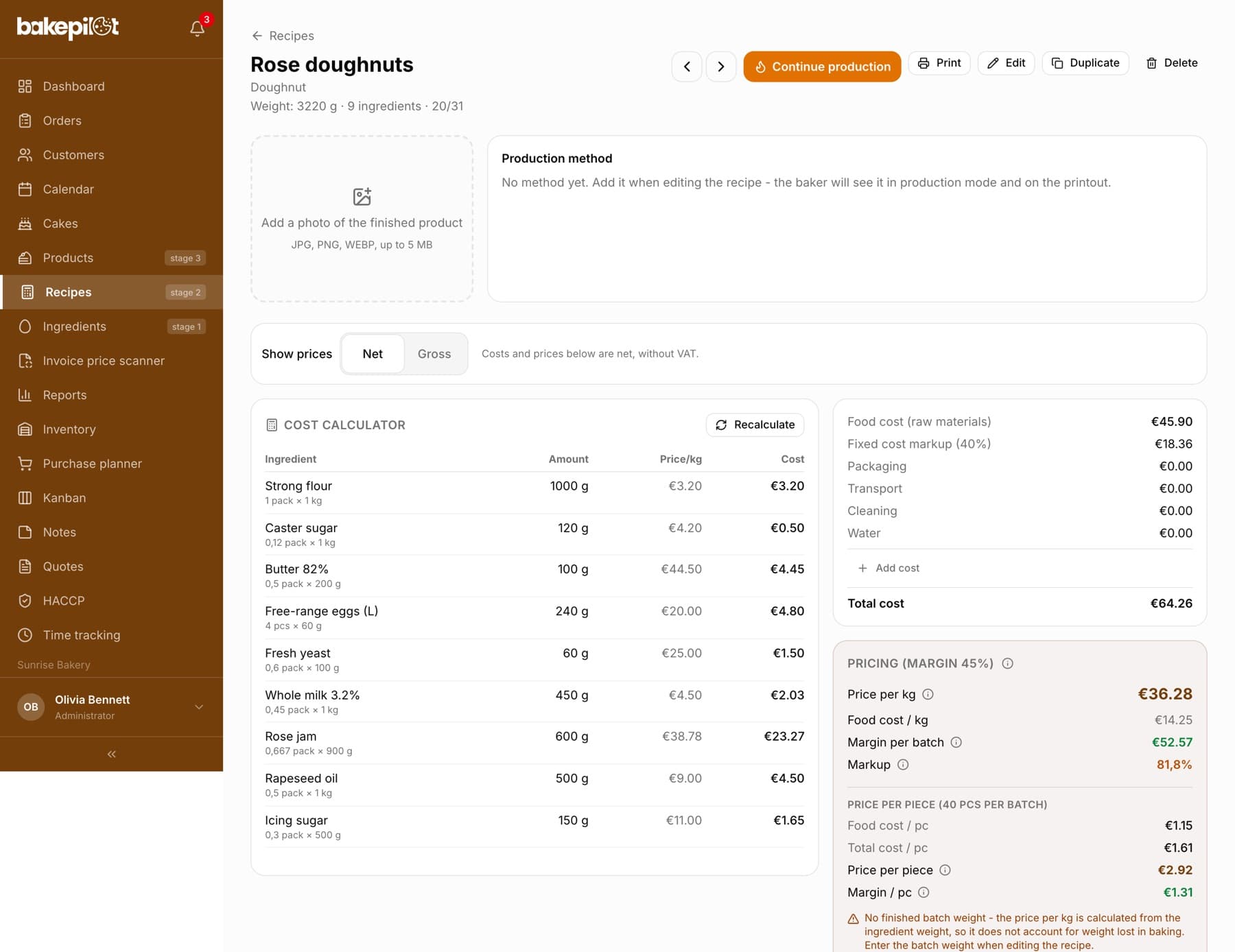
After saving, you see the cost of the whole batch and the conversion per piece. In the example the ingredients cost 45.85 PLN, and with the 40% fixed cost markup (18.34 PLN), the mixer's electricity and the additional costs, the total cost is 71.63 PLN. The “Price per piece (40 pcs per bake)” block says: food cost 1.15 PLN, total cost 1.79 PLN, price 3.26 PLN, margin 1.47 PLN per piece.
- Food cost / pc 1.15 PLN - the raw materials alone for one doughnut
- Total cost / pc 1.79 PLN - with the markup, electricity and packaging
- Price per piece 3.26 PLN - from the 45% margin (the price at which 45% of the price remains)
- Margin / pc 1.47 PLN - how much remains from one piece
The product and the “1 pc” variant
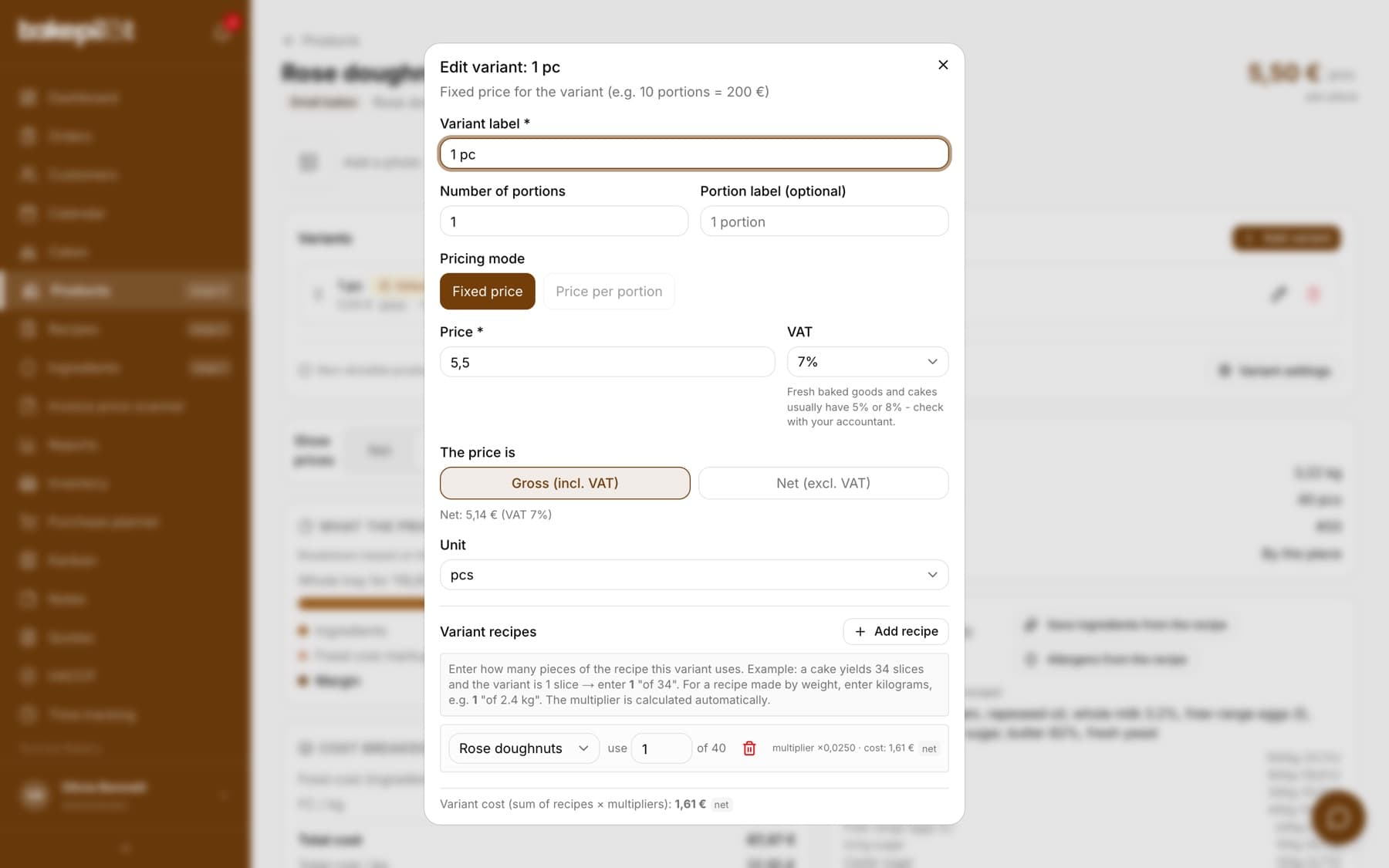
The “Rose doughnut” product gets the Small bakes category, a price of 5.50 PLN and the “Rose doughnuts” recipe. Untick “Sold by weight”. On the product card, add a “1 pc” variant with a price of 5.50 PLN gross and 8% VAT, and in the variant's recipes enter “use 1 of 40”. The variant cost will be 1.79 PLN net.
- Products, Add: name, category Small bakes, price 5.50, recipe “Rose doughnuts”, untick “Sold by weight”, Add product.
- Click the product, then “See more”. On the card, click “Add variant”.
- Label “1 pc”, number of portions 1, Fixed price 5.50, VAT 8%, Gross, unit pcs.
- Add recipe, choose “Rose doughnuts”, enter 1 in the “use … of 40” field.
- Tick “Set as the product's default variant” and save.
A box of 6 as a second variant
Do you also sell doughnuts in boxes of six? Add a second variant: label “Box of 6”, number of portions 6, price for example 30 PLN gross, unit pack, and in the variant's recipe “use 6 of 40”. The variant cost is calculated as 6/40 of the recipe cost. When taking an order, the salesperson picks “1 pc” or “Box of 6” from the list.
Tip: Do not create a separate product for the box. One product, two variants - sales statistics and the purchase planner will then count the doughnuts together.
Pitfalls
Three things that most often spoil the result in this scenario.
- The weight of one piece entered as the batch weight - prices come out 40 times too low. The weight is the whole batch.
- Eggs as pieces with a package weight of 0 or 1 - check the “Net price/kg” column on the ingredient list; an egg should have a single-piece weight of about 60 g.
- Changing the tile from “Pieces” to “Kilograms” quietly switches the pricing method to “Margin %”, because a price per piece makes no sense by weight. Check this field after the change.
Frequently asked questions
Can I have one recipe for several kinds of doughnuts?
Yes, if they differ only in a filling of a similar price. If the filling is expensive (for example pistachio), make a separate recipe with “Duplicate” on the recipe card and swap the ingredient - the cost will be accurate.
The price per piece on the product card (3.26 PLN) is different from the variant price (5.50 PLN). Which one is right?
They say different things. 3.26 PLN is the price calculated from the recipe and your target margin - a suggestion. 5.50 PLN is the price you actually set on the variant and sell at. If the variant is more expensive than the suggestion, you earn more than the assumed margin.